Anguilla Real Estate
The Caribbean's most understated ultra-luxury beach market — 33 beaches, and not one cruise ship.
Why invest in Anguilla
- 33 beaches — no cruise ships, casinos or high-rises
- Meads Bay & West End beachfront scarcity
- Four Seasons-anchored branded market
- Tax-neutral British Overseas Territory
Who is buying Anguilla now.
Anguilla's pitch is everything it has declined to build. A low-lying coral island a short hop north of St. Maarten, it counts 33 beaches and permits none of the machinery of mass tourism — no cruise terminal, no casinos, no high-rises. What remains is arguably the finest run of white sand in the region, and a market that prices that restraint directly. The axis of value is Meads Bay and the West End — the stretch where the island's serious capital has settled, with the Four Seasons estate as its anchor and the boutique villa clusters near Cove Bay a short drive south. Beachfront scarcity, not volume, sets the price here.
The buyers are a consistent type. US East Coast families who want a beach house their children will argue over rather than a trading position; tax-planning relocators weighing the territory's flat-tax residency; and privacy seekers — families who made their money conspicuously and would prefer to enjoy it quietly. A newer cohort has joined them: British and European high earners recalibrating their base as home-country regimes tighten, drawn to one of the region's few genuinely zero-tax jurisdictions. What they share is an indifference to spectacle — Anguilla has no skyline and no scene, and the buyers Dan sends there feel no absence. The market itself is thin by design, with limited inventory and low turnover, which rewards patience on the way in and protects value on the way out.
Dan places the island in the region's tax-neutral tier alongside the Cayman Islands and The Bahamas, but as its discretion play — Cayman is the institutional base, The Bahamas trades on scale and proximity to Florida, and Anguilla is where the same money goes to be left alone. The distinction matters for buyers, because it is the reason this market has stayed boutique while its peers built volume.
Where the value sits: Meads Bay, the West End and Cove Bay
Geography is the whole argument in Anguilla, and it concentrates on the western half of the island. Meads Bay is the most valuable sand — a long, calm crescent that carries the Four Seasons estate and the highest prices on the island. The wider West End holds the balance of the branded and estate product, with quiet lanes running down to a string of near-empty bays. Cove Bay sits a short drive south: lower-key, unspoiled, and the setting for a new generation of boutique villa projects, one of which adjoins a resort home to what the island bills as the second-ranked golf course in the Caribbean. Around the island's harbors, a marina-side pocket is emerging for owners who arrive by boat as readily as by ferry. Dan's rule for a first-time buyer is simple: on Anguilla you are buying a specific beach and a specific approach road, not a postcode, and a few hundred meters of frontage is most of the price.
What to buy: from boutique villas to beachfront estates
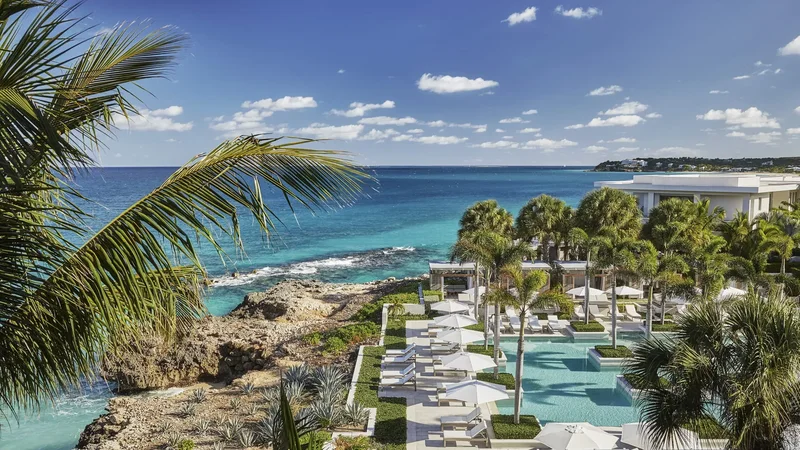
For most of its history the villa market here was a market of one-off commissions — private homes built to a family's taste and rarely resold. The current cycle has brought a wider ladder. At the top, the Four Seasons beachfront villas on Meads Bay anchor the branded end: a completed four-bedroom, freehold villa of roughly 403 square meters, resort-managed and enrollable in the Four Seasons rental program, at $7,950,000. That is branded product on the island's best sand, with the resale depth a global flag creates in a thin market; the wider Four Seasons Anguilla community sets the standard the rest of the island is measured against.
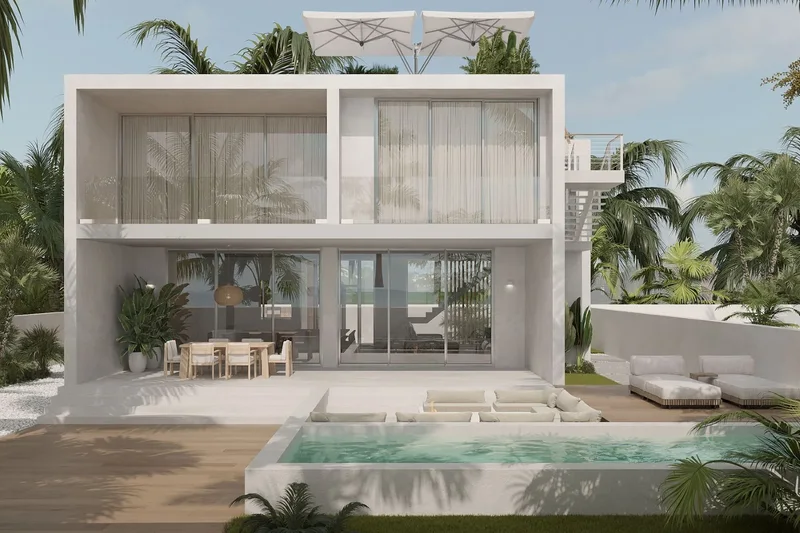
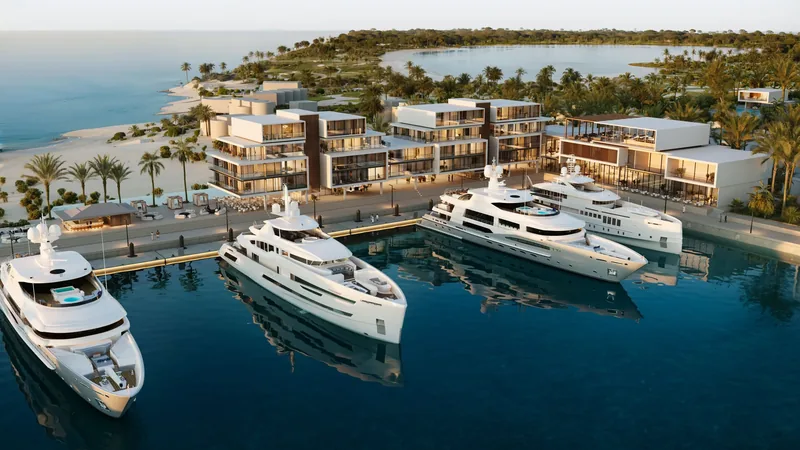
Below the anchor, the mix has genuinely widened. The boutique saltwater-pool villas near Cove Bay bring managed, lock-and-leave ownership — two-bedroom, freehold homes of about 295 square meters built around a private pool, from $1,395,000. The forthcoming forthcoming marina and oceanfront residences add marina-front living across one- to five-bedroom homes from $1,500,000, with completion expected in 2028; Dan's read on that project sits in his note on Marina Residences & Villas's Equinox marina residences. Newer names keep surfacing off-plan — his early view on one of them is in the piece on Savi Beach Anguilla — and the island's finest whole-ownership estates still trade quietly, often entirely off-market. For buyers weighing branded product across the region, his ranking of six Caribbean branded residences is the honest place to start.
Residency, the flat tax and the citizenship question
No purchase here delivers a passport at closing — Anguilla is a British Overseas Territory and runs no citizenship-by-investment program. Its offer is residency. The Residence by Investment program's real-estate route starts at $750,000 of approved, qualifying property, which is where the villa market trades in any case, so in practice the home does the qualifying work; a development-fund contribution is the alternative. A qualifying application covers up to four family members, and lawful residency in turn opens a pathway to British Overseas Territory Citizenship after five years. Dan runs the search against the program's requirements from the first viewing, and the full process and fine print sit on the Anguilla residency page.
The deeper draw is tax. Anguilla levies no personal income tax, no capital-gains tax and no inheritance tax — standing policy, not a promotional scheme. For families who want the island as their tax home, the separate High-Value Resident program sets the terms at a flat annual tax of $75,000, a qualifying property of $400,000 or more and a minimum presence requirement of 45 days a year; a purchase at the residency level clears that property threshold comfortably, so the same villa can carry both arrangements. The regional comparison — and the honest arithmetic on whom the fixed fee actually suits — sits in Dan's guide to flat tax programs in the Caribbean. US citizens, taxed on worldwide income wherever they live, get its full effect only alongside the far larger step of renouncing US citizenship, and Dan says so early.
How foreigners buy here: ownership, closing and financing
Foreign buyers take title freehold, and the villa market is structured for them — the branded and boutique projects are sold to international owners as a matter of course. As in Britain's other Caribbean territories, a non-national purchaser typically needs an alien-landholding license, a standard, document-driven consent that Dan coordinates with island counsel rather than a barrier to entry. Beyond the headline price, buyers should budget for government transaction and legal costs and, on managed product, for ongoing service and rental-program fees; Dan sets those expectations before an offer, not after.
Financing is the one place to plan carefully. Local mortgage lending to non-residents is selective and conservative, and most Anguilla purchases settle in cash or against facilities arranged offshore — the realities are laid out in Dan's guide to getting a mortgage on a Caribbean villa. On off-plan projects such as Marina Residences & Villas, payments are staged against construction and completion runs to 2028, so the diligence is on the developer and the contract as much as the view.
Access, via St. Maarten
There is no long-haul runway on the island, and no plan for one. Most owners fly into St. Maarten's international hub and cross by ferry or a short connecting flight; private aviation lands on Anguilla directly. The crossing costs minutes and works as the island's velvet rope — no cruise crowds, no day-trippers, few casual weekenders. For a US East Coast family the door-to-beach day is entirely workable, and Dan tells buyers to treat the last leg as part of what they are purchasing. How the island stacks up against markets with nonstop service home is the subject of his piece on which Caribbean islands are a direct flight home.
Risks and trade-offs
The case against Anguilla is the mirror image of the case for it. The market is thin, so both entry and exit reward patience — the best villas trade on relationships and rarely sit on a public listing, and a forced sale is the wrong way to leave. Off-plan product carries the usual completion and timing risk. The island sits in the hurricane belt, and insurance and resilient construction are real line items rather than afterthoughts. And the same restraint that keeps the beaches empty means no deep on-island banking bench and no nonstop long-haul flight home.
So Dan places families honestly. Those who need a full-service island — schools, infrastructure, direct long-haul flights — are usually better served by Barbados. Those who want an institutional financial base lean to the Cayman Islands; those who prize scale and Florida proximity to The Bahamas. Anguilla is the region's quiet pole: the island for the family that wants one of the Caribbean's finest beaches at the end of the garden and little else on the horizon. How it sits against the other markets Dan covers is mapped on the regional real-estate guide.
How Dan works the island
Anguilla is a relationship market, and pricing discipline comes from knowing what has actually closed rather than what is merely listed. Dan works the island buy-side through his Sotheby's International Realty affiliation: sourcing across the branded and boutique pools, underwriting what a villa truly costs to run and return, and coordinating the residency or flat-tax file alongside island counsel. Current inventory sits on the listings page, the region's approved projects on the developments hub, and pricelists, floorplans and comparables in the private dataroom, by appointment.
Developments & opportunities.
Anguilla real estate, answered.
Is Anguilla eligible for citizenship or residency by investment?
Residency, yes; citizenship, no. Anguilla is a British Overseas Territory and runs a Residence by Investment program whose real-estate route starts at $750,000 of approved property, alongside a development-fund contribution option. The full process and terms are on Dan's Anguilla residency page.
What does real estate in Anguilla typically cost?
Current entry points run from $1,395,000 for the boutique saltwater-pool villas near Cove Bay and $1,500,000 at the Marina Residences & Villas to $7,950,000 for a Four Seasons beachfront villa — with the island's finest beachfront estates trading quietly, often off-market. Dan maps the right level to your budget on the first call.
Does buying a villa in Anguilla give me residency?
Not automatically, but it usually can. A qualifying purchase of approved property at $750,000 or more anchors the Residence by Investment application, and because the villa market trades at or above that level, the home typically does the qualifying work. Dan plans the purchase and the application as one file.
How does Anguilla's $75,000 flat tax relate to the property market?
The High-Value Resident program grants tax residency for a flat annual tax of $75,000 alongside a qualifying property of $400,000 or more and a minimum presence requirement of 45 days a year. A purchase at the residency level clears the property threshold comfortably, so the same villa can carry both arrangements — the full mechanics are in Dan's guide to flat tax programs in the Caribbean.
How do I get to Anguilla?
Most owners fly into St. Maarten's international hub and cross by ferry or a short connecting flight; private aviation lands on the island directly. Dan treats the extra leg as the island's filter — it is much of why Meads Bay stays quiet in high season.
Why are there no high-rises or cruise ships in Anguilla?
Policy, not accident. The island has chosen low density deliberately — no cruise terminal, no casinos, no high-rises — and that restraint is what protects both the beaches and the long-term value of the little that is built.
How does Anguilla compare with Barbados?
They are opposite poles of the same region. Barbados is the full-service island — infrastructure, schools, direct long-haul flights — with a treaty-based tax system; Anguilla is the quiet, tax-neutral one, reached with one extra leg by design. Many families weigh both, and the answer usually turns on how the family actually plans to live.
Thinking about Anguilla?
Dan lives and works in the region. Book a call for an honest, first-hand read on the market.
Book a Private Call