Jumby Bay
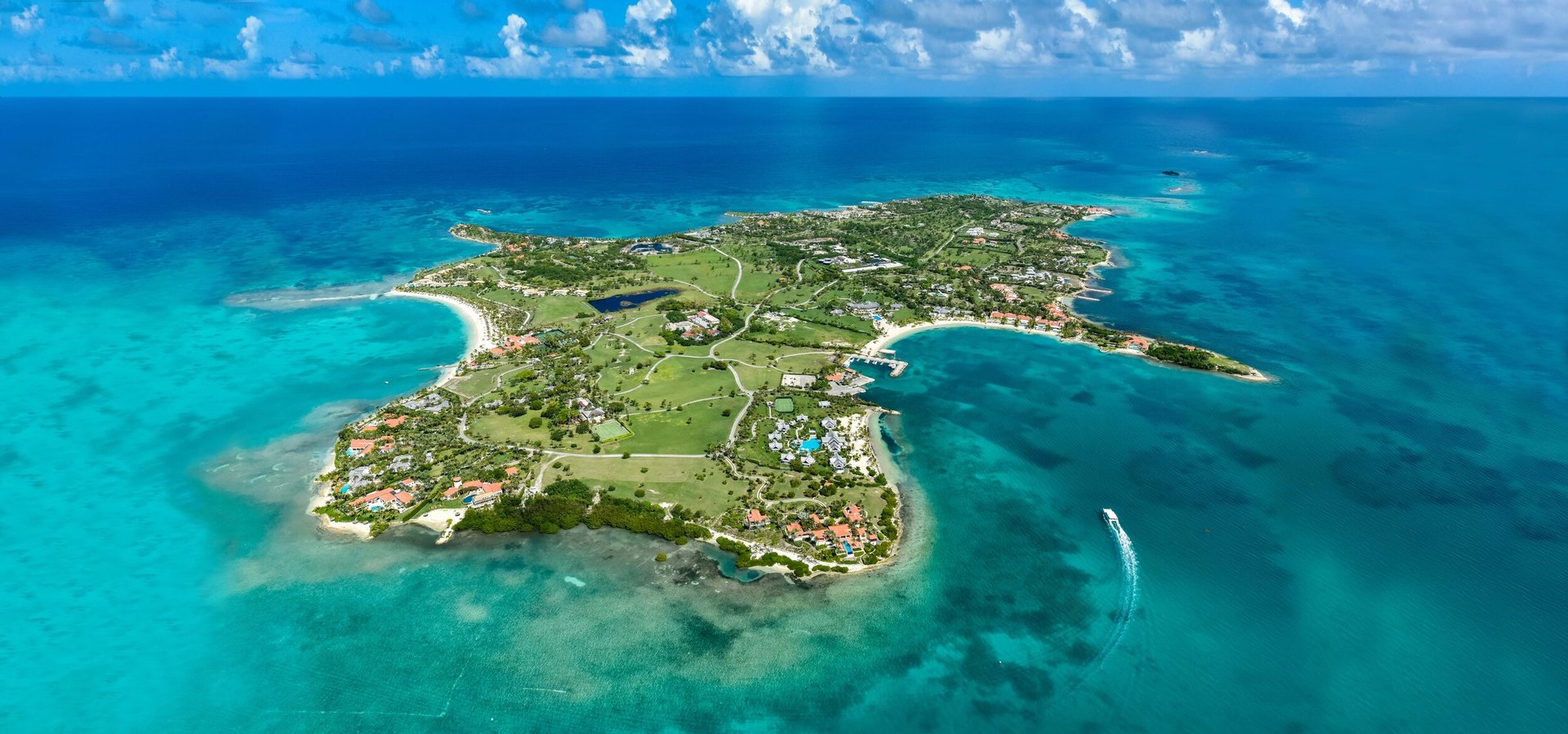
A 300-acre private island off Antigua — a Rosewood resort with ultra-private homes and estates.
Jumby Bay is a 300-acre private island a short ferry from Antigua, home to a Rosewood resort (the island recently rebranded to Rosewood, having previously operated under the Oetker Collection) and a small, tightly held community of estates and villas. It's car-free, intensely private, and one of the most established ultra-luxury addresses in the Eastern Caribbean.
Because it's part of Antigua & Barbuda, a qualifying purchase can intersect the country's citizenship-by-investment program. Homes trade rarely; the value is in access and timing.
Jumby Bay is a 300-acre private island off the coast of Antigua, reachable only by boat on a crossing of about six minutes, and the thing most buyers get wrong about it is which direction the ownership runs. They picture a resort that sells villas around its edges. It is closer to the opposite. There are 56 private residences on the island, each held individually on a freehold basis, and each one carries a single and equal share in Jumby Bay Island Company Ltd — the company that owns the freehold to everything else: the resort, the undeveloped common land, neighbouring Maiden Island, the utilities, the ferries and the docks. The island has belonged to its homeowners since 1998. Buy a house at Jumby Bay and you are not a guest with a deed. You are one fifty-sixth of the landlord.
The second thing buyers get wrong is more expensive. Because Antigua runs a citizenship-by-investment program, and because Jumby Bay is a well-known Antiguan address, people arrive assuming the two connect. They do not. Jumby Bay does not appear on the Citizenship by Investment Unit's list of approved development projects, and it is not named in the CIU's schedule of approved areas. I go through that in detail below, because it is the single point on which I have seen the most confident misinformation, usually from people who are not paid to be careful about it. Let me be blunt from the top: treat Jumby Bay as a house you want to own, not as a route to a passport.
What you actually own at Jumby Bay
The legal structure at Jumby Bay is unusual, and it is the reason the island feels the way it does. Each of the 56 properties is individually owned on a freehold basis, and each holds a single and equal share in Jumby Bay Island Company Ltd, which owns the freehold to everything else — the neighbouring Maiden Island, the undeveloped common land, the resort, the utilities, the ferries and the docks. The island has been in its homeowners' hands on this basis since 1998.
Read that twice, because it has consequences a brochure will not spell out:
- You are a shareholder in the company that owns an operating hotel. Not a member of an amenity club. The resort sits inside the company you part-own, which means the hotel's capital needs sit on the same balance sheet as the island's. What that actually costs you is a question for the audited accounts, not for a sales brochure.
- Your share of the vote is fixed and small. One share in 56, equal to every other. You cannot accumulate influence by buying a bigger house. Ask for the company's articles and read how decisions are carried and what majority binds you — that detail is not published anywhere, and it matters more than the view.
- The infrastructure is not a public utility. The ferries, the docks and the power are company assets, held by the company the 56 of you own between you. When they need replacing, that is your balance sheet, not the Antiguan government's.
- The hotel brand is a contractor, not an owner. The resort has been operated by Oetker Collection since 2017. Rosewood ran it before that, and a great deal of listing copy, older brochures and even the national tourist board's own page still describe the property as "Jumby Bay, A Rosewood Resort." That branding is roughly a decade out of date. If the material in front of you says Rosewood, it is old, and you should ask what else in it is old.
Practically, the island runs without cars — they are not allowed — and people move around by bicycle and golf cart. Everything and everyone arrives by boat. Pasture Bay, the most sheltered and undeveloped beach on the island, is the site of a hawksbill turtle monitoring effort described as the longest-running privately funded project of its kind. It is a genuine conservation program, and if you are buying anywhere near it, it is worth asking in writing what it implies for what can be built.
The honest carrying costs, and the number I cannot give you
Antigua's transaction costs for a foreign buyer are knowable and I will give them to you. The ongoing cost of being a Jumby Bay shareholder is not published, and I am not going to invent it.
On the way in, a non-Antiguan buyer needs a Non-Citizen Landholding Licence. The licence fee is typically 5% of the property value, and the application takes roughly three to six months to process. Buyer's stamp duty is 2.5% of the property value, and legal fees usually run around 1% to 2% of the purchase price. So before you have bought a single deck chair, budget something in the region of 8.5% to 9.5% on top of the price — and build the three-to-six-month licence window into your timetable, because it is the item that most often breaks a completion date. Those percentages come from Antiguan professional guidance rather than a government fee schedule I could pull directly, so have your own attorney confirm each one against the current order before you rely on it.
On an ongoing basis, Antiguan property tax on residential property runs between 0.1% and 0.5% of assessed value. Antigua does not levy personal income tax, capital gains tax or inheritance tax on its tax residents, and ABST is 15% generally, 14% on hotel and restaurant services. On a large villa, none of those are the number that matters.
The number that matters is the annual assessment from Jumby Bay Island Company Ltd, and it is not public. You are funding a share of a private island's entire operating base — power, water, boats, docks, grounds, security, staff — divided 56 ways, plus the running cost of your own house, which on a fully staffed estate is a payroll, not a service charge. Anyone who quotes you a confident annual figure for Jumby Bay dues off the top of their head is guessing. Get the company's audited accounts and the last several years of assessments before you go firm on a price, and read them for capital calls, not just the annual number. When a hurricane takes out a dock, there is no external landlord to send the invoice to. It goes to the company the 56 of you own.
One tax point I will not let slide, because it applies to a large share of the buyers who look at this island: if you are a US citizen, none of Antigua's tax treatment changes your position. The United States taxes its citizens on worldwide income regardless of where they live or where the asset sits, and the only exit from that is renouncing citizenship. A Caribbean address is not a US tax plan.
Renting out a Jumby Bay villa, and how much control you keep
Oetker Collection manages the resort and the rental of the villas and estate homes, so owners have a route to put their houses to work when they are not in them. This is the part of the proposition that gets oversold, so here is the shape of it honestly.
The upside is real. Robb Report, writing in November 2023 about an estate then listed on the island, described it as among the most requested rental homes and said it generates more than seven figures of rental income per year. That is a genuine number for a genuine house — and it is one house at the very top of the market, not the middle of it. Treat it as the ceiling, not the expectation.
The trade-offs are structural:
- The operator is the channel. Rental of the residences runs through the resort operator. This is not a property you list yourself and market on your own terms, and your yield is therefore a function of how well the hotel is performing.
- Occupancy and your own use compete. Every week you block for family is a week off the revenue line, and on a seasonal Caribbean island the weeks you most want are the weeks that earn most.
- Rental income is not the return. A staffed island villa carries fixed costs whether it is let or empty. Run the numbers as a cost-offset against ownership, not as an investment yield, and you will make a better decision.
- The revenue split matters and I have not seen it published. Ask for the actual management agreement — commission, marketing deduction, who pays for refurbishment cycles, and what standard the operator can require you to meet. That last one is where owners get surprised.
Jumby Bay is not a citizenship route — and 2026 is the wrong year to assume otherwise
Antigua and Barbuda's citizenship-by-investment program has a real estate option: property valued at a minimum of US$300,000, submitted on the strength of a binding purchase and sale agreement signed with the developer of an approved project, and not resaleable for five years after purchase unless you roll into another officially approved property. Government processing fees are US$10,000 for a single applicant and US$20,000 for a family of up to four, with a further US$10,000 for each additional dependant beyond that. The cheapest route into the program is not property at all — it is the National Development Fund contribution, at US$230,000 per application. The Antiguan passport carries visa-free or visa-on-arrival access to 154 destinations on the Henley 2026 index.
Here is the problem. The real estate option requires an approved project or an approved area, and Jumby Bay is named on neither of the CIU's published lists. The approved development projects list runs to around thirty names — Hodges Bay Resort & Spa, Nonsuch Development Company, Galley Bay Heights, Moon Gate and the rest — and Jumby Bay is not among them. The approved areas schedule covers stretches such as Fort James to Blue Waters, Pearns Point to Johnson's Point, Willoughby Bay to Half Moon Bay, and Guiana Island and its environs to Crabbs Peninsula to Indian Point. Jumby Bay is not named, and neither is Long Island, the island it sits on.
So: if citizenship is what you are buying, Jumby Bay is not the instrument. If someone tells you otherwise, ask them to point at the CIU listing, and get written confirmation from the Unit itself before a cent moves. I would say the same about any property anywhere that is sold to you with a passport attached.
And there is a timing issue that applies to the whole region, not just Antigua. In letters dated 25 June 2026, the European Commission asked five Eastern Caribbean states — Antigua and Barbuda, Dominica, Grenada, St Kitts and Nevis, and St. Lucia — to phase out their investor-citizenship programs by 1 June 2028, with visa-free Schengen access as the leverage. Under the EU's revised visa suspension mechanism, operating such a program at all is now treated as a standalone ground for suspending visa-free access, however well the program is run. The Commission also expects reinforced vetting in place by September 2026. This is a formal request rather than an order, and no final decision has been made — but anyone treating a Caribbean CBI passport as a settled long-term asset in 2026 is carrying a policy risk they should at least be pricing. That is an argument for buying Jumby Bay because you want Jumby Bay, which, conveniently, is the only sound reason to buy it.
Again, for US buyers: acquiring a second citizenship anywhere does nothing to your US tax position. American citizens are taxed on worldwide income wherever they live, and renunciation is the only way out of that.
How it compares, and the risks I would raise before you make an offer
There are two honest comparisons, depending on what you actually want.
If you want Antigua plus citizenship, the comparison is not Jumby Bay at all — it is the mainland CIU-approved developments, where a US$300,000 purchase in a listed project does qualify. You will get a smaller, more conventional asset in a more liquid market, and a passport. You will not get a private island.
If you want a homeowner-controlled private island, the closest structural analogue in the Caribbean is Mustique, where the Mustique Company controls the island's infrastructure and services and most of the villa owners hold shares in it. Note the difference, though: at Jumby Bay every one of the 56 properties carries a share and every share is equal, which is a tighter arrangement than "most owners hold shares." My reading of Mustique comes from dated reporting, so treat it as a starting point for your own enquiries rather than a current description. Either way, both structures put you inside a small, closed shareholder body alongside your neighbours. Some buyers find that reassuring. Some find out too late that they hate it.
The risks I would put in front of you unprompted, before an offer:
- Liquidity is genuinely poor. There are 56 properties in total. Transactions are therefore rare, and public price evidence is correspondingly thin. The estate Robb Report covered in November 2023 was asking US$40 million — reported at the time as the highest listing price in Antigua's history — for a 6,900 sq ft, four-bedroom house on 1.13 acres of beachfront. I do not know how that listing resolved, and neither does anyone quoting it at you as a comparable. One public data point is not a market.
- Concentration risk in the company. Fifty-six shareholders funding a resort, a boat fleet and an island's infrastructure. If the resort underperforms or a major asset needs replacing, the cost lands on a very small number of people.
- Operator risk is proven, not theoretical. The brand over the hotel has already changed once, in 2017. A future change affects your rental channel, your resale narrative and arguably your valuation.
- Single-point access. Cars are not allowed and the island is reachable only by boat. That is the charm and it is also the operational exposure — for storms, for staffing, for medical situations, and for the cost of every item delivered to your door.
- Exit costs and hurricane insurance. I have no reliable figures for either at this specific address, and both tend to surface late in a transaction. Ask for real seller-side numbers and a real insurance quotation before you agree a price, not after.
None of this is an argument against Jumby Bay. In my view the ownership structure is better aligned than most branded-residence schemes I look at, for a simple reason: the people making the decisions have their own money in the same pot as yours. It is an argument for buying it with your eyes open, at a price that reflects a thin market and an annual assessment nobody has shown you yet. That is the part I am for.
Frequently asked questions
Does buying a home at Jumby Bay qualify me for Antigua citizenship?
No, not on the published rules. Antigua's real estate route requires a purchase of at least US$300,000 in a project on the Citizenship by Investment Unit's approved development projects list, or in one of its designated approved areas. Jumby Bay does not appear on the approved projects list, and neither Jumby Bay nor Long Island is named in the schedule of approved areas. If citizenship is your objective, look at the mainland approved projects or the National Development Fund contribution instead, and get any qualification confirmed in writing by the CIU before you commit money.
What does a house at Jumby Bay cost?
There is no reliable published range. There are only 56 properties on the island, so sales are rare and public price evidence is thin. The one prominent public data point is an estate listed in November 2023 at US$40 million, reported at the time as the highest asking price in Antigua's history, for a four-bedroom, 6,900 sq ft house on 1.13 acres of beachfront. Treat that as a single point at the very top of the market, not as a guide to what anything else is worth. Anyone quoting you a confident price range for the island is estimating.
What are the annual fees and running costs at Jumby Bay?
The Antiguan side is knowable: residential property tax runs between 0.1% and 0.5% of assessed value, and Antigua levies no personal income tax, capital gains tax or inheritance tax on its tax residents. The Jumby Bay Island Company assessment is not published, and I will not guess at it. You are funding a share of an entire island's operating base — power, water, boats, docks, security, grounds — split 56 ways, plus your own villa's staffing. Ask for the company's audited accounts and several years of assessment history, and look specifically for capital calls rather than just the recurring figure.
What does it cost to buy in Antigua as a foreigner, and how long does it take?
A non-Antiguan buyer needs a Non-Citizen Landholding Licence, which typically costs 5% of the property value and takes around three to six months to process. Add buyer's stamp duty of 2.5% and legal fees of roughly 1% to 2%. Budget somewhere around 8.5% to 9.5% in acquisition costs on top of the purchase price, and treat the licence timeline as the item most likely to move your completion date. These are the figures Antiguan professionals publish rather than a government fee schedule, so have your own attorney confirm them before you rely on them.
Can I rent my Jumby Bay villa out when I'm not using it?
Yes. Oetker Collection manages the resort and the rental of the villas and estate homes, so there is an established channel. One Jumby Bay estate was reported in November 2023 as generating more than seven figures of rental income a year, but that was a standout property at the top of the market rather than a typical result, and I have seen no published owner revenue split. Before you count on rental income, get the actual management agreement and read the commission structure, the marketing deductions, who funds refurbishment cycles, and what condition standards the operator can impose on you.
Is Jumby Bay still a Rosewood resort?
No. Oetker Collection has operated the resort since 2017; Rosewood ran it before that. A lot of listing copy, older sales material and even the national tourist board's own page still say "Jumby Bay, A Rosewood Resort," which is simply stale. It is a useful test of any document you are handed: if it still says Rosewood, check the date on everything else in it too.
I'm American. Does owning at Jumby Bay or getting a Caribbean passport help my tax position?
No. The United States taxes its citizens on worldwide income regardless of where they live or where the property sits, and renouncing US citizenship is the only exit from that. Antigua's lack of income, capital gains and inheritance tax on its tax residents is real, but it does not change what you owe the IRS. Any adviser who suggests otherwise is one you should stop talking to.
Dan advises buyers independently across this community — on which product, ownership structure and price actually fit your goals.
Book a Private Call


Explore Jumby Bay with Dan.
Book a private call to see current availability, ownership structure and pricing.
Book a Private CallDan Merriam & Associates acts for the buyer. Our advice is independent, not contingent on any sale, and we hold no brokerage or developer mandate.